

Italicize book titles; use quotation marks for shorter works; place commas and periods inside.
If you write, edit, or publish, you need clean titles. This guide shows how to punctuate book titles in clear, simple steps.
I’ve edited thousands of pages and seen the same errors again and again. Follow along, and you will master how to punctuate book titles with confidence and ease.

Source: wikihow.com
Why punctuation for book titles matters?
Titles are tiny but mighty. They guide your reader’s eye and set the tone. Good punctuation keeps meaning clear and builds trust. It also signals that you follow a standard.
Many writers ask how to punctuate book titles when a sentence already has commas or quotes. The answer depends on a few steady rules and the style you use. Pick a style, learn the pattern, and stay consistent.

The core rule set at a glance
Two big style families shape how to punctuate book titles in US English. Know which one your audience expects.
- Academic and publishing style
- Books and other long works: italics. Example: Have you read Moby-Dick?
- Parts of books (chapters, poems in a book, essays): quotation marks. Example: “The Library of Babel.”
- Periods and commas go inside closing quotation marks.
- Newsroom style
- Many news outlets put book titles in quotation marks. Example: “Beloved” is on my list.
- The Bible and some reference works often appear without quotes.
- Periods and commas still go inside closing quotation marks.
When in doubt, check your house style. If you work across fields, note the shift. This keeps how to punctuate book titles aligned with reader expectations.

Source: wikihow.com
Italics, quotation marks, and punctuation placement
Here is a simple path you can use right away.
- Use italics for stand-alone works
- Books, novels, textbooks, anthologies, plays, and long poems take italics.
- Example: I finally finished War and Peace.
- Use quotation marks for shorter works or parts
- Chapters, essays, short stories, and poems inside collections take quotation marks.
- Example: I love “A Good Man Is Hard to Find.”
- Punctuation with quotation marks in US style
- Periods and commas stay inside the closing quote. Example: I just reread “Song of Myself.”
- Colons and semicolons stay outside. Example: She assigned “Everyday Use”: we discussed it Friday.
- Question marks and exclamation points depend on meaning.
- If the title has the mark, keep it. Example: Have you read Are You There God? It’s Me, Margaret.
- If your sentence is the question, put the mark after the title. Example: Did you enjoy “The Swimmer”?
- Italics next to punctuation
- The punctuation next to an italic title is not italic unless it is part of the title.
- Example: Have you started Invisible Man? The question mark is not italic.
Keep these in mind whenever you plan how to punctuate book titles. They solve most cases fast.
Colons, subtitles, series, volumes, and editions
Subtitles love colons. Series and editions bring commas and abbreviations. Use this quick map.
- Title and subtitle
- Use a colon to join them. Capitalize the first word after the colon.
- Example: Sapiens: A Brief History of Humankind.
- Series and volume
- You can include series info after the title. Use a colon or place series info after the main title.
- Example: The Fellowship of the Ring: Being the First Part of The Lord of the Rings.
- Or use a comma with an abbreviation. Example: The Cambridge History of Medieval England, Vol. 2.
- Edition and translator
- Add edition and role details with commas. Example: Don Quixote, trans. Edith Grossman, 2nd ed.
- Keep the book title in italics. Keep the added details in roman text.
This section comes up often when people ask how to punctuate book titles for research papers and catalogs.

Titles within sentences: commas, parentheses, possessives, and other tricky spots
Complex sentences can make titles look messy. Use these simple fixes.
- Possessives of titles
- Put the title in italics or quotes. Add the possessive ending outside.
- Example: Moby-Dick’s structure is bold. “The Lottery’s” twist still shocks.
- Parentheses and brackets
- Keep the title format inside the parentheses. Example: I skimmed the intro (see “The Gift of the Magi”).
- Punctuation goes outside the parentheses unless the whole sentence is inside them.
- Titles ending in a question or exclamation
- Keep the mark from the title. Do not add a second one.
- Example: We just debated Who’s Afraid of Virginia Woolf? in class.
- Commas around appositives
- Use commas to set off a title when it renames a noun. Example: Her first book, Beloved, won many awards.
These steps help you show how to punctuate book titles in real, messy sentences.
Special cases and exceptions
A few items sit near books and share rules that can confuse writers. Here is how to handle them.
- Sacred and reference works
- Some styles do not italicize the Bible and major reference books. Others do. Follow your style and be consistent.
- Example: I compared passages in the King James Bible.
- Legal cases and court reports
- Many general styles italicize case names. Example: Brown v. Board of Education.
- In legal writing, special rules apply. Follow that field’s norm.
- Foreign-language titles
- Keep italics for the original title. Add a translation in parentheses and in roman type.
- Example: Cien años de soledad (One Hundred Years of Solitude).
- Ebooks and audiobooks
- Treat them like print. Format the title the same way. Add format notes only in references if needed.
Knowing these limits will sharpen your sense of how to punctuate book titles across contexts.

Source: wikihow.com
Common mistakes and how to fix them
Avoid these errors I see often in manuscripts and marketing copy.
- Using quotation marks for a book title in academic work
- Fix: Use italics for stand-alone books.
- Dropping the colon before a subtitle
- Fix: Add a colon and capitalize the first word after it.
- Letting the possessive s slip into italics
- Fix: Keep only the title in italics. The apostrophe and s stay in roman.
- Putting commas and periods outside quotes in US style
- Fix: Keep them inside. Example: “The Metamorphosis,” not “The Metamorphosis”.
- Double punctuation at sentence ends
- Fix: Use one mark. If the title ends with ?, do not add a period.
These quick checks answer core parts of how to punctuate book titles without stress.
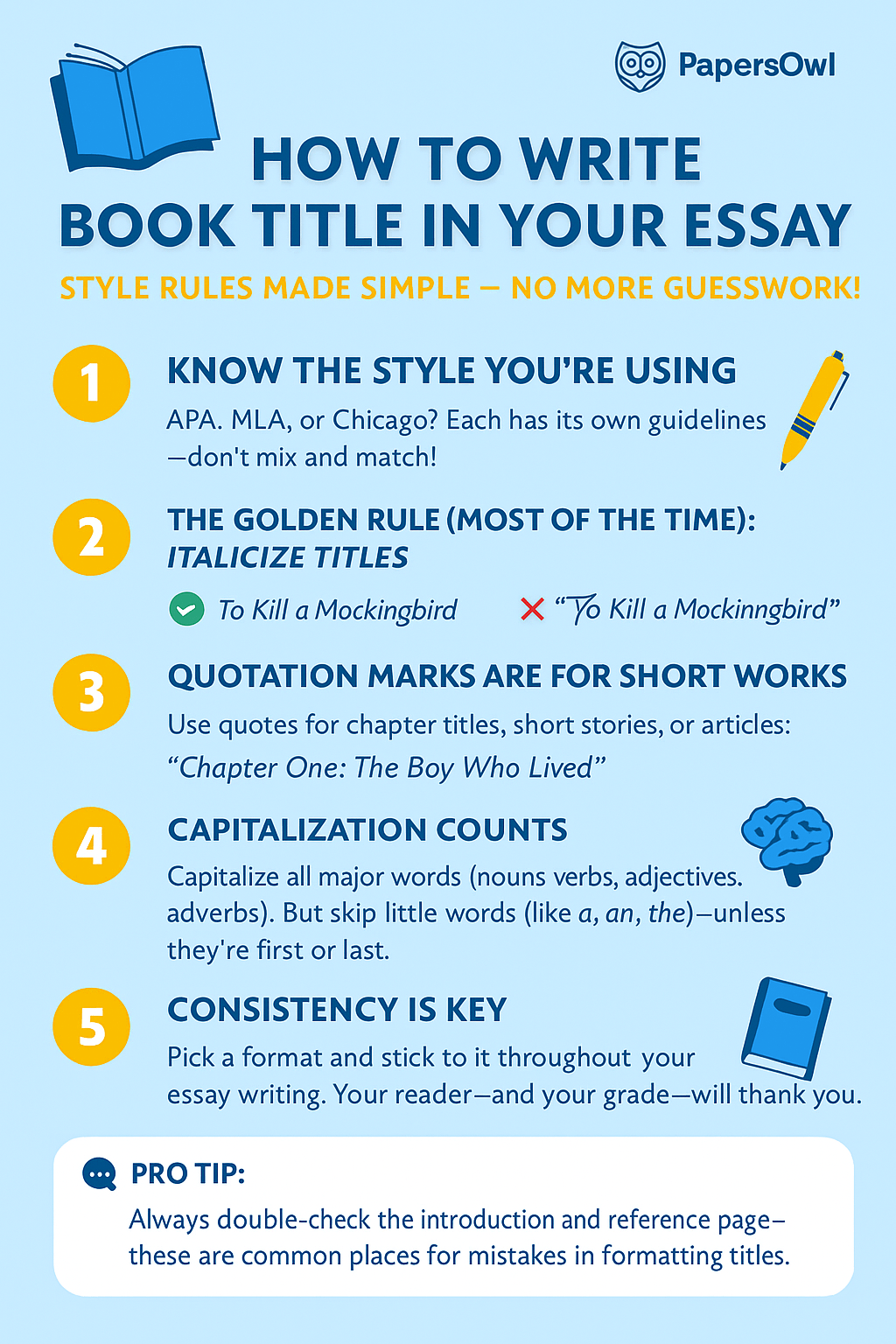
Source: papersowl.com
A simple step-by-step checklist for how to punctuate book titles
Use this checklist when you draft, edit, or proof.
- Identify the work. Is it a book or a part of a book?
- Choose the format. Italics for books. Quotation marks for parts.
- Add subtitles with a colon. Capitalize the first word after the colon.
- Place periods and commas inside closing quotation marks.
- Keep colons and semicolons outside closing quotation marks.
- Let question marks and exclamation points follow the logic.
- For possessives, keep the title formatted; put ’s outside.
- For series, volumes, and editions, add commas or abbreviations as needed.
- Apply the same rule set every time. Consistency is key.
- Do a final read-aloud pass to spot odd punctuation.
Run this flow each time you think about how to punctuate book titles, and it will soon feel automatic.
Frequently Asked Questions of how to punctuate book titles
Do I italicize every book title?
Yes, in most academic and publishing contexts, book titles take italics. Some news styles use quotation marks instead, so follow your audience’s standard.
Should a subtitle always follow a colon?
Yes. Use a colon between the main title and subtitle and capitalize the first word after the colon. Keep any internal punctuation that belongs to the title.
Where do commas and periods go with quoted titles?
In US English, periods and commas always go inside the closing quotation mark. Colons and semicolons go outside.
What if the book title ends with a question mark?
Keep the question mark as part of the title. Do not add another period at the end of your sentence.
How do I make a possessive with a book title?
Format the title, then add the possessive outside. Example: “Jane Eyre’s” themes or Moby-Dick’s symbolism.
Do I treat ebooks or audiobooks differently?
No. The title formatting is the same as print. Add format details only when citing sources or in a reference list.
Can I use underlining instead of italics?
Only if italics are not available, such as on a typewriter or in plain-text systems. In standard digital or print work, use italics.
Conclusion
You now have a clear and simple path for tidy titles. Use italics for books, quotes for parts, and place marks where they belong. With a set checklist and a steady style, how to punctuate book titles will feel easy and natural.
Make this your next habit. Edit one page today and fix every title you see. Want more quick guides like this? Subscribe for fresh tips, or drop your questions in the comments.